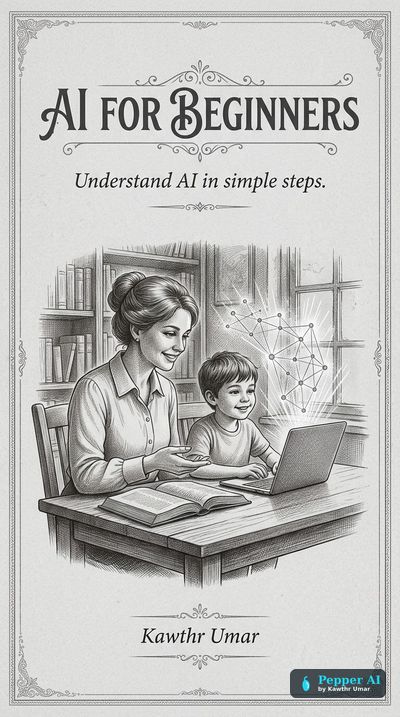
Artificial intelligence, or AI, is computer software that can do tasks which normally need human thinking, such as understanding language, recognizing faces in photos, translating between languages, or suggesting the next word you type.
AI does not think or feel the way people do. It has no opinions, no memories of its own, and no understanding of the world in the way you have. What it has is a remarkable ability to find patterns in huge amounts of information and use those patterns to make a good guess.
A helpful way to picture it is a very fast assistant that has read an enormous library but sometimes mixes facts up. It can save you hours of work, and it still needs your judgment. This book will show you how to use that assistant wisely, from your very first conversation to safe everyday habits.
A Short History of AI
The idea of thinking machines is old, but the field of AI began in 1956, when a group of researchers met at Dartmouth College in the United States and used the name "artificial intelligence" for the first time.
For decades, progress was slow. Computers were weak and data was scarce. In 1997, a computer called Deep Blue beat the world chess champion Garry Kasparov, which showed that machines could master a narrow task. In 2016, a program called AlphaGo beat a top player at the ancient board game Go, which was far harder for computers.
In the 2020s, AI chat tools arrived that could write, explain, and answer questions in everyday language. Millions of people started using them. The big change was not that machines became human, but that powerful AI became easy for ordinary people to use, with no coding at all.
How AI Learns
Most modern AI learns from examples, not from a list of rules typed by a programmer. This is called machine learning. Imagine showing a child thousands of pictures of cats until they can recognize a cat they have never seen. AI learns in a similar way, but with far more pictures and far more speed.
AI chat tools are trained on very large amounts of text. From it, they learn which words and ideas usually go together. When you ask a question, the tool builds an answer one piece at a time, choosing what is most likely to fit.
This explains both its strength and its weakness. It is excellent at writing smoothly and explaining common topics. But it is predicting what sounds right, so sometimes it states something false with total confidence. Always remember: smooth does not always mean correct.
Everyday AI You Already Use
You probably use AI every day without noticing. When your phone suggests the next word, when a map app finds the fastest route, when a streaming service recommends a film, or when your email moves junk messages to the spam folder, AI is working behind the scenes.
Voice assistants turn your speech into text and answer your questions. Cameras can focus on faces. Banks use AI to spot unusual payments that might be fraud. Online shops use it to suggest products you may like.
Seeing AI in daily life removes the mystery. It is not a robot from a film. It is ordinary software that is good at one job. As you learn more, you will start noticing where it helps you, and where you would rather decide for yourself.
Using AI Chat Tools
AI chat tools let you type a request and receive an answer in seconds. Write to the tool the way you would write to a helpful friend. Be clear about what you want, who it is for, and how long or detailed the answer should be.
For example, instead of typing "write about healthy food", try "write a simple 150-word guide to healthy breakfasts for busy students, as a short list". The second request gets a far better answer.
Treat the first answer as a draft. Reply with changes such as "make it shorter", "use easier words", or "give me three more ideas". You can also ask the tool to explain something step by step, or to explain it as if you were ten years old. Practicing for ten minutes a day will quickly build your confidence.
AI for Study, Work and Creativity
For study, AI can explain a hard topic in simple words, make practice questions, summarize your own notes, or help you plan a revision timetable. Use it to understand, not to copy, because your teachers and your own learning both depend on your effort.
At work, it can help you draft emails, organize ideas, prepare meeting notes, translate messages, and brainstorm names or slogans. It saves time on first drafts so you can spend your energy on the parts that need a human touch.
For creative projects, AI can suggest story ideas, titles, or colors, and it can help you get unstuck. The best results come when you add your own experience and taste. Your voice is the part nobody else can supply.
Limits and Mistakes of AI
AI makes mistakes. It can invent facts, names, dates, and even sources that do not exist. It may also reflect unfair patterns found in the data it learned from. It does not know about events after its training, unless it can search the internet.
It also lacks real understanding of your situation. It cannot see your feelings, your local laws, or the full picture of your life. So for health, legal, or money decisions, treat its answer as a starting point and speak to a qualified person.
A simple habit protects you: check anything important in a second trusted source. If the tool gives a statistic or a quote, look it up. Ask it, "How sure are you?" and "What could be wrong with this answer?" These questions often reveal weak spots.
Staying Safe and Next Steps
Never type passwords, bank details, identity numbers, or private information about other people into an AI tool. Assume anything you type could be stored. Check the privacy settings of the tool you use, and read how it handles your data.
Be honest about how you use AI. If a school, employer, or customer expects your own work, follow their rules. If you publish something AI helped you write, read it carefully, correct it, and add your own knowledge so it truly reflects you.
You now have the foundation. Your next steps are simple: choose one AI tool, use it for one small task each day for two weeks, and keep a note of what works. Then move on to the Prompt Writing Guide on this site to get even better answers. Learning AI is a skill, and every day of practice makes it easier.